tl;dr: The andon cord isn't a tool–it's a trust signal. Toyota's thousands of line stops reflect psychological safety and leadership support. Ford's rare pulls reflected fear and mistrust. Lean succeeds or fails on culture, not mechanics.
In 2007, a BBC article about lean manufacturing included a stunning detail. Workers at Toyota's Georgetown, Kentucky plant were pulling the andon cord — the mechanism that signals a problem and can stop the production line — roughly 2,000 times a week. Workers at a brand-new Ford truck plant in Dearborn, Michigan were pulling it twice a week.
I wrote about that contrast here at the time, and the post has lived on because the question it raises hasn't gone away. The numbers aren't really about cord-pulling. They're about whether people believe it's safe to surface problems — and whether leadership has earned that belief. I've had the chance since then to talk through the Dearborn story in depth with Jeff Liker and with Mike Hoseus, who helped build Toyota's culture from the inside at Georgetown. What they added changes the picture somewhat. So I've updated the post to include it.
On the assembly line at Toyota's giant plant, Laura Wilshire is not happy.
There is something wrong with a seatbelt fitting on the Camry she is working on.
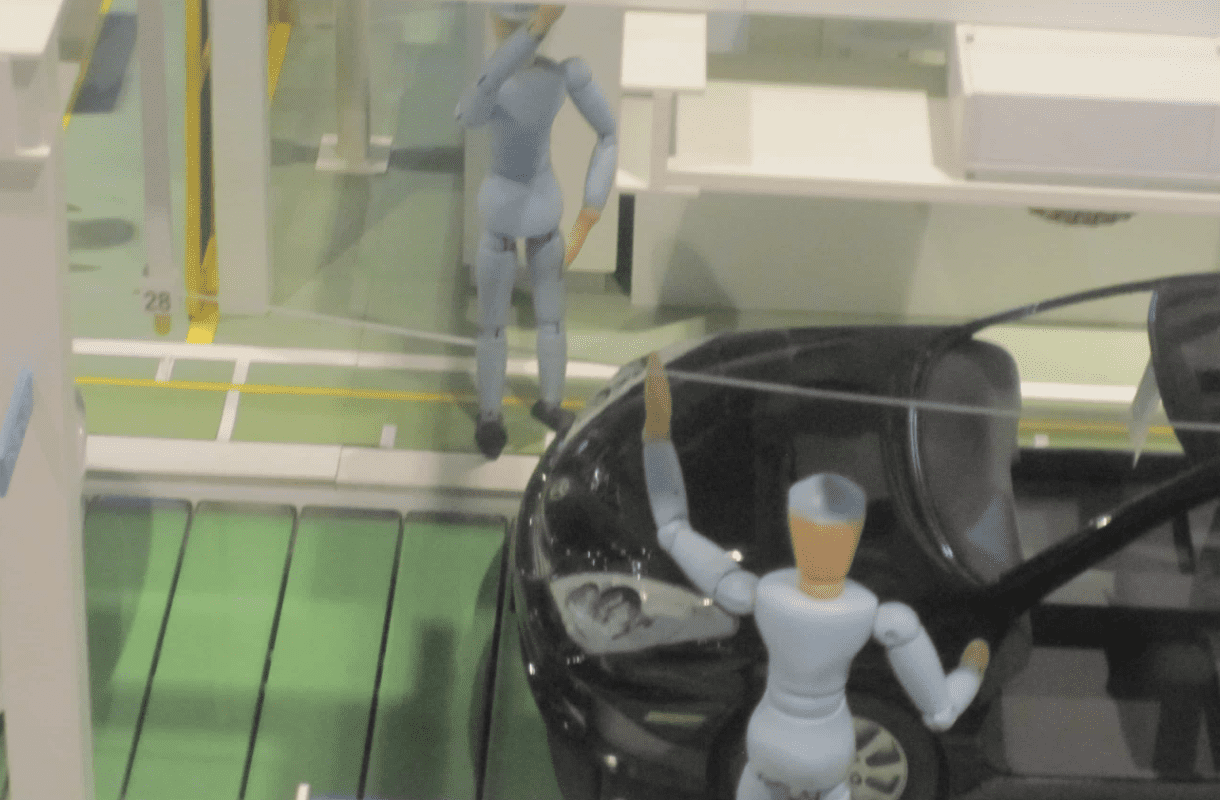
Laura pulls a cord, stopping the production line – and prompting her five fellow workers on trim line three to crowd round.
They soon see why it is not screwed in properly and fix the problem.
“I don't like to let something like that go,” she says. “That's really important for people who buy our cars.”
Stopping the Line at Toyota: Quality Comes First
The andon cord (sometimes a button in modern plants) is a mechanism that lets any worker signal a problem on the production line the moment they spot a defect or abnormality. The line might even stop as a result. The name comes from the Japanese word for lantern; the system typically triggers lights and a tone so the team leader knows exactly where to respond. At Toyota, pulling it is expected. It doesn't come naturally, even there.
There's a huge cultural difference between Toyota and Ford. Even with Ford's attempts at rebranding the “Ford Production System,” all of the lean design and lean documentation doesn't matter if you're not going to “manage lean, ” including letting workers pull the cord to fix quality problems (jidoka–building in quality by stopping when problems occur).
The Andon Cord as a Measure of Trust
Here's a stunning difference:
Workers at the Toyota plant in Georgetown, Kentucky, pull the cord 2,000 times a week – and their care is what makes Toyota one of the most reliable, and most desired, brands in the US.
Mark: (Many of these pulls are for small issues caught early–exactly the kind of problems that never show up in final inspection data.)
In contrast, workers at Ford's brand-new truck plant in Dearborn, Michigan, pull the cord only twice a week – the legacy of generations of mistrust between shop-floor workers and managers.
Fewer Problems–or Just Less Speaking Up?
Why do you think the Ford workers were only pulling the cord twice a week? Did they have fewer problems than Toyota's assembly line?
Liker told me that Ford actually put serious effort into that plant from the start. They worked with former Toyota people for a couple of years before opening. They created a team leader role — workers trained in problem-solving who would be offline and ready to respond to andon pulls — which is structurally how Toyota makes the cord work. Without someone to respond quickly, the signal just creates chaos. Ford understood that.
Then Ford Finance got involved. They looked at Kentucky Truck, which was building the same F-series trucks without the team leader structure, and told the Dearborn team: we're going to compare your output and quality to Kentucky Truck's. If the team leader role doesn't prove its value, we're eliminating it. The plant couldn't do anything about that.
Liker's read: the effort was real, but the legacy culture — the old seniority-based bumping and bidding system, the historic relationship between the floor and management — won. The BBC's conclusion that it was “generations of mistrust” was accurate, he said, just not a full explanation. They didn't ask why more than once.
He added something I've thought about since: he believes the Dearborn approach would have worked, given time and the right conditions. “I can't prove that,” he told me, “but that's what I believe.” Which is an honest answer, and a more useful one than just calling it a failure of lean.
The BBC article doesn't dig deeper into Ford, but instead looks at GM's efforts to catch up to Toyota from a labor productivity standpoint. But it mentions nothing about quality or how GM's “andon” (not “andan” as the BBC spelled it) process works any better than Ford's. GM has had the chance to learn from Toyota at NUMMI, so you'd hope they would have a more robust line stop and quality improvement process. Do they?
Mike Hoseus — who worked at Toyota's Georgetown plant and later co-authored Toyota Culture with Liker — told me the story of how the andon cord was likely invented, tracing it back to jidoka on Toyota's looms and, possibly, San Francisco cable cars. The physical cord was a design decision, he suggested, not just a tool decision. That episode is worth your time if you want the origin story.
At a deeper level, the question is whether GM and Ford – the companies that perfected mass production -can fundamentally change their culture to the new lean production system.
“I hope they make it – but I am not optimistic they all will be able to,” says James Womack, an expert who has advised many global companies, from Tesco to Boeing, on the advantages of lean production.
Mr Womack says it has to be something that is inculcated in all the company's workers, from the bosses to those on the factory floor.
“This is not Japanese companies vs American companies, it is smart Japanese companies vs smart American companies,” he says.
“GM has caught up on assembly plants, but Toyota is still ahead on suppliers, product development and a problem-solving approach to issues.
“For too long, managers at US car companies were in denial about their problems.”
If the cord gets pulled twice a week, you might tell yourself there just aren't many problems. That's usually the wrong answer. The more likely answer is that people have learned what happens when they do pull it — and decided it isn't worth it.
Womack's comment from 2007 still sits with me: “For too long, managers at US car companies were in denial about their problems.” That's not a manufacturing observation. It's a leadership one.
One thing I'd genuinely like to know: if you worked at the Dearborn plant, or at any Ford facility during that era when they were trying to build TPS-style systems, what did it look like from the inside? Liker's account tracks with what I've heard elsewhere, but there are details you can only get from people who were there. The comments are open.
[…] I’d be curious to know the details behind “was replaced later in the assembly process with the correct one.” I’d hope, in a way, that the problem was just not detected until later. If the defect HAD been discovered, the good practice from Lean and the Toyota Production System would be to stop the line so it didn’t have to be fixed later. Some Big Three (Detroit Three) plants have struggled with the culture change required to allow workers to “stop the line” when they see a problem (like this fairly recent story about a Ford truck plant). […]
[…] Read this classic tale from 2007 about the mindset differences at Toyota (you must stop the line) ve…duction). I’m guessing that, at Boeing, it’s OK to stop the line because they value root cause problem solving and the prevention of other problems. This is a Lean principle used at Virgina Mason Medical Center (also in Seattle). They use the principle in their “patient safety alerts” which emphasizes calling out problems (or risks) when you see them and getting the problem resolved for future prevention (this goes well beyond normal “fire fighting”). See related blog posts about this concept at VMMC. […]
[…] Read this classic tale from 2007 about the mindset differences at Toyota (you must stop the line) ve…duction). I’m guessing that, at Boeing, it’s OK to stop the line because they value root cause problem solving and the prevention of other problems. This is a Lean principle used at Virgina Mason Medical Center (also in Seattle). They use the principle in their “patient safety alerts” which emphasizes calling out problems (or risks) when you see them and getting the problem resolved for future prevention (this goes well beyond normal “fire fighting”). See related blog posts about this concept at VMMC. […]








[…] equipment), but your culture is one where supervisors yell at people for stopping the line (as written about here), it’s a bad […]
[…] I’d be curious to know the details behind “was replaced later in the assembly process with the correct one.” I’d hope, in a way, that the problem was just not detected until later. If the defect HAD been discovered, the good practice from Lean and the Toyota Production System would be to stop the line so it didn’t have to be fixed later. Some Big Three (Detroit Three) plants have struggled with the culture change required to allow workers to “stop the line” when they see a problem (like this fairly recent story about a Ford truck plant). […]
[…] Read this classic tale from 2007 about the mindset differences at Toyota (you must stop the line) ve…duction). I’m guessing that, at Boeing, it’s OK to stop the line because they value root cause problem solving and the prevention of other problems. This is a Lean principle used at Virgina Mason Medical Center (also in Seattle). They use the principle in their “patient safety alerts” which emphasizes calling out problems (or risks) when you see them and getting the problem resolved for future prevention (this goes well beyond normal “fire fighting”). See related blog posts about this concept at VMMC. […]
[…] Read this classic tale from 2007 about the mindset differences at Toyota (you must stop the line) ve…duction). I’m guessing that, at Boeing, it’s OK to stop the line because they value root cause problem solving and the prevention of other problems. This is a Lean principle used at Virgina Mason Medical Center (also in Seattle). They use the principle in their “patient safety alerts” which emphasizes calling out problems (or risks) when you see them and getting the problem resolved for future prevention (this goes well beyond normal “fire fighting”). See related blog posts about this concept at VMMC. […]