Interview with Keith Ingels on Developing Your People and Making Lean /TPS Your Own
Scroll down for how to subscribe, transcript, and more
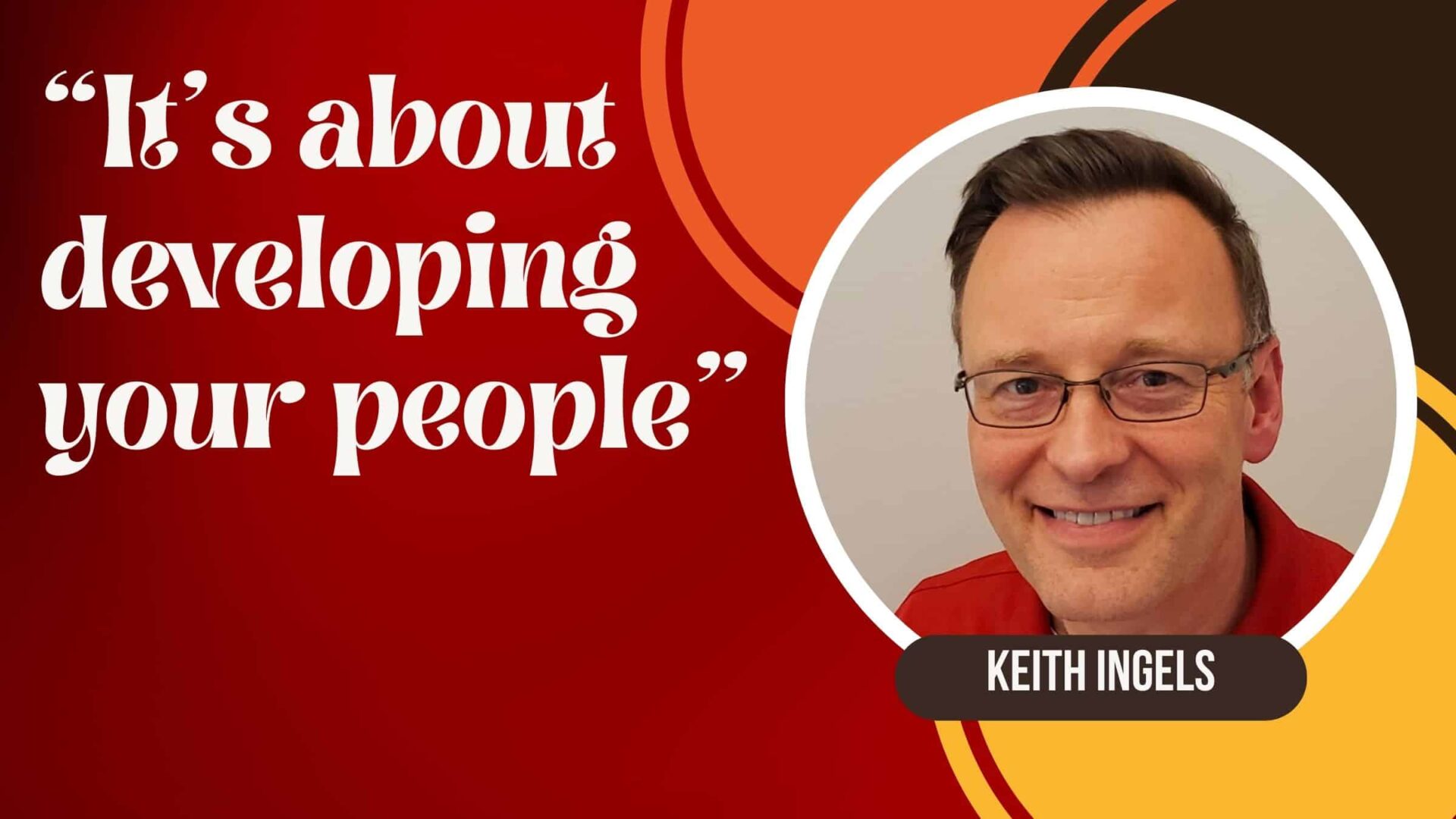
My guest for Episode #484 of the Lean Blog Interviews Podcast is Keith Ingels, who previously joined us in Episode 390. He's the RLM Manager of Solutions & Support Centers — RLM being the Raymond Lean Management system.
He was also a guest with me for Episode 62 of “My Favorite Mistake.” His story and insights were also featured in Chapter 8 of my book, The Mistakes That Make Us: Cultivating a Culture of Learning and Innovation.
In today's episode, we discuss how the Raymond Corporation makes Lean / TPS their own management system, even while being under the Toyota corporate umbrella. RLM focuses on developing people and that starts with leaders. Why does a culture of continuous improvement start with small steps and not requiring ROI calculations for every improvement? We discuss how kaizen participation rates are a leading indicator of employee morale and how absenteeism and turnover are lagging indicators. We talk about that and more…
“Critique the process, not the people.”
Summary and Key Takeaways
The Strategic Foundation: RLM & Toyota
- Ownership of the Journey: While Raymond is a Toyota company, they rebranded their system to RLM (Raymond Lean Management). The lesson: For Lean to stick, an organization must own it and adapt the language to fit its own culture rather than just “copy-pasting” Japanese terms.
- Product Synergy: Raymond focuses on narrow-aisle electric equipment, while Toyota focuses on internal combustion and sit-down units. They even manufacture for each other. This is a “Value Stream” mindset at a corporate level.
- The TPS House: The goal isn't just “results.” Results are the roof. To keep the roof up, you must focus on the foundations (Workplace Set/5S) and the pillars (Flow/Just-in-Time and Quality/Jidoka). You drive the inputs, not the results.
Cultivating the “Continuous Improvement” Mindset
- The Power of Fresh Eyes: New employees are a goldmine for Kaizen because they haven't been “indoctrinated” by tribal knowledge. They have Problem-Seeing Eyes.
- Assumptions vs. Knowledge: Leaders often confuse an assumption for a fact. The coach's job is to ask, “How do you know that?” to move the team from guessing to true Gemba-based knowledge.
- The “Why” Behind the Buy: In sales (and internal projects), don't just provide what is asked for (e.g., 10 trucks). Ask, “What are you trying to achieve?” Usually, the equipment is incidental to a larger goal, like increasing throughput.
Psychological Safety & Leadership
- “Critique the Process, Not the People” (Takaki D): When things go wrong, the focus must be on the process gap. If a leader blames a person, they effectively kill future Kaizen.
- Problem-Speaking Mouths: Having “problem-seeing eyes” is useless if the culture doesn't support “problem-speaking mouths.” Safety isn't a one-time speech; you must reinvent the safe environment every day through your reactions to bad news.
- The ROI of Coat Hooks: Not every Kaizen needs a massive financial return. Small wins, like adding coat hooks for workers, build trust and morale. If you solve the “small” problems that annoy people, they will eventually solve the “big” problems that save the company money.
The Evolution of Teaching: “Microbursts”
- The 70/20/10 Rule: Learning is 10% formal, 20% social, and 70% experiential.
- Avoid “PowerPoint Pedaling”: You can't learn to ride a bike via a slideshow. Raymond moved to Microburst Teaching: brief, focused lessons followed immediately by hands-on coaching and application.
- PDCA as a Learning Tool: The “Check” in Plan-Do-Check-Adjust isn't about pass/fail. It's about measuring the gap between what you expected and what actually happened. That gap is where the learning lives.
The podcast is sponsored by Stiles Associates, now in its 30th year of business. They are the go-to Lean recruiting firm serving the manufacturing, private equity, and healthcare industries. Learn more.
This podcast was also brought to you by Arena, a PTC Business. Arena is the proven market leader in Cloud Product Lifecycle Management (PLM) with over 1,400 customers worldwide. Visit the link arenasolutions.com/lean to learn more about how Arena can help speed product releases with one connected system.
This podcast is part of the #LeanCommunicators network.

Full Video of the Episode:
Thanks for listening or watching!
This podcast is part of the Lean Communicators network — check it out!

Transcript:
Introduction
Announcer: Welcome to the Lean Blog Podcast. Visit our website at www.Leanblog.org. Now, here's your host, Mark Graban.
Mark Graban: Hi, it's Mark Graban. This is episode 484 of the podcast. It's September 6th, 2023. Joining me today is a returning guest. He's Keith Ingels from the Raymond Corporation, which is part of Toyota Industries. So you'll learn more about him in a minute. We have a great conversation about their adaptation of the Toyota Production System to their business. In Raymond, we talk about the foundations of the TPS house, we talk about developing your people, and all sorts of other great topics related to continuous improvement and Lean today. For more information, look in the show notes, or you can go to Leanblog.org/484.
Well, hi everybody. Welcome back to Lean Blog interviews. I'm Mark Graban. Joining us today is a returning guest. He is Keith Ingels. He is from the Raymond Corporation. Keith was our guest back in episode 390, October 2020. He is currently the RLM manager of Solutions and Support Centers, RLM being the Raymond Lean Management System. So we're going to be able to talk about that and all sorts of things here today. So Keith, welcome back to the podcast. How are you?
Keith Ingels: Thanks, Mark. Great to see you. Appreciate you having me back today.
Mark Graban: Yeah. It's great to have you back. And this is my mistake. Keith was also a guest in the My Favorite Mistake podcast. I will make sure to put a link to that in the show notes. I don't remember the episode number, Keith, but…
Keith Ingels: I don't remember the episode number. It was great fun, it was good learning for me. I make a lot of mistakes. They're great learning.
Mark Graban: Well, we all–well good. And that's the thing, right? Learning from those mistakes. I think we'll have a chance to explore that a little bit more today as we did in that episode. And, you know, thank you again for sharing some of your stories and reflections on kind of working on the culture. Sorry to be self-promotional on the book, The Mistakes That Make Us, but I did incorporate some of your lessons learned in chapter eight of the book. So thank you again for that.
Keith Ingels: Oh, thank you. It's great pleasure.
About the Raymond Corporation
Mark Graban: So for those who did not hear episode 390 in this series, Keith, maybe first off, if you can tell us a little bit about the Raymond Corporation and its place within Toyota Industries.
Keith Ingels: Sure, Mark. Raymond Corporation is a wholly owned subsidiary of Toyota now. We just celebrated our 100th year as an organization last year in 2022. So the organization's been around for a long time. We focus on material handling and logistics solutions–a whole array of solutions. We're probably best known for making forklifts and material handling equipment. We do systems and all sorts of other things. We've been a wholly owned division of Toyota since 2000, and we have learned from Toyota and grown under their guidance. I actually came from the Toyota side over to the Raymond side just over 10 years ago. So it's great fun to work in this industry and logistics. There's always new challenges and new things coming at you.
Mark Graban: Yeah. And so that probably creates all sorts of opportunities to use Lean, TPS, or RLM, as you're calling it. How are the Raymond products–how do they fit in with, you know, people have probably seen Toyota branded forklifts?
Keith Ingels: Yes.
Mark Graban: How does the Raymond product line fit in compared to Toyota forklifts?
Keith Ingels: Well, that's a great question, Mark. We actually manufacture separately. Under the Toyota brand, we manufacture what we call the internal combustion and the electric sit-down equipment. At Raymond, we focus in narrow aisle or very narrow aisle equipment–the standup so you can get a more narrow aisle for put away. And also the sit-down and walkie equipment, the small hand pallet jacks, et cetera. So we manufacture different things. We make the electric standups for Toyota; Toyota makes the electric sit-down for Raymond. So it's a very closely coordinated effort.
Defining Raymond Lean Management (RLM)
Mark Graban: Okay. Well thanks for telling us about that. Let's talk about your role and maybe just some of the terminology that has evolved. Back in 2020, your title was TPS manager of Toyota Production System within Raymond Corporation. Tell us about the role and the terminology involved in it.
Keith Ingels: Sure. So I started on the Toyota side, so I learned from the source. I'm very comfortable, for example, in the Toyota Japanese terminology. That's what I kind of grew up with in continuous improvement. But coming over to the Raymond side, we had to be very diligent about training continuous improvement for two reasons. One, we had a history of innovation, but continuous improvement gave us a more structured approach. But the other piece we learned from Toyota Production System is that it's very important to own your own journey in continuous improvement.
So we changed to reference our journey as Raymond Lean Management. Well, why? It is the Toyota Production System, but it's ours. It's Raymond's adaptation. You'll see some differences in how we apply and understand it. All the structure mechanics are the same, but for example, we use more English words than the Japanese. I still like the Japanese, but I don't want students to get hung up on trying to pronounce terminology versus the concept we're trying to convey. And we also, as we go out into customer sites, we advise our customers the same thing: You need to own this, it's yours. Call it whatever fits for you, but you own it. It's helped us take it forward to a different level.
The Foundations of the TPS House
Mark Graban: Yeah, there's endless debate around the use of Japanese words. Sometimes the Japanese word prompts someone to ask, “What is Kaizen?” and maybe triggers some new thinking. But there are times when people overdo it in a way that puts up barriers. When you talk about a structured approach to continuous improvement, how would you describe that structure?
Keith Ingels: Well, we create the path and we always refer back to the Toyota Way and the TPS House, which contains the foundational elements.
You're going to see the development of standards and Kaizen in there. We keep “Kaizen” because we haven't found a good English equivalent, so we use it routinely. In the basic structure, we talk about Workplace Set: Can we visually confirm that we have all the tool supplies and training we need in the workplace? From there, we go into the two pillars, traditionally referred to as Just-In-Time and Jidoka. We will talk about them as Flow and Quality often, or delivering a customer experience of on-time and defect-free.
And then, of course, the roof of the TPS house is the results. We talk about how the roof protects a house and results protect an organization. But we also caution in our coaching: You can't drive results. You drive inputs. You drive workplace readiness and foundational elements. Am I ready to do work? Am I fixing my flow? Do I have the right quality?
We have a 6,000-person distribution network in North America, and we coach them to focus on the step immediately in front of them. People get excited and want to jump to an end goal, but you can't make those leaps. If what you have today is better than yesterday, that's Kaizen–roll it out, try it, and keep working on it.
Developing People and “Critique Process, Not People”
Mark Graban: You touched on something there, Keith, that some organizations miss. Better quality improves flow, and better flow improves quality. They go hand-in-hand. I'm curious if you can elaborate on how to navigate helping someone “unlearn” the idea that Lean is only about speed.
Keith Ingels: Well, you're bringing up a great point. One of the first things we teach is that continuous improvement is about developing your people. It's about developing people to see and understand the workplace. We want them to come in with “problem-seeing eyes” first and then move to problem-solving. We find the challenge is not so much the solving–solving is usually not difficult if you can see the problem.
We are never the expert of the work being done; the person doing the work is the expert. The value-add we bring as coaches is asking really great questions because we're looking at that workplace from the outside. If the workplace is not well-set, they'll struggle with flow and quality.
We find it is really important to start with leadership. The best leaders focus on process improvements. There's a Japanese concept called Takaki D, which is: Critique process, not people.
Mark Graban: Takaki D. I've learned a new one! I like that word “critique” because “being hard on the process” can sound a bit loaded. Critique is something that leads to improvement.
Keith Ingels: Exactly. “Hard” often translates to people. One of the first things we identify is the culture of learning. Is it a culture of “blamestorming” instead of brainstorming? People really want to contribute. Even at customer sites, we assume we know the value-add, but we might not truly know what the next customer in the process needs.
Partnering for Customer Success
Keith Ingels: When we go to customer sites, we go to Gemba (the workplace). One customer, Longfield Gardens, had a highly seasonal business with many seasonal workers. We asked them how they were conveying their culture and expectations. They didn't have many visuals. They ended up taking courses from us and embraced it for themselves. They changed their communication and their visuals, and their culture strengthened as a result.
One of my favorite Kaizens there involved coat hooks. The VP of Operations showed me these coat hooks and said he was really proud of them. He said they didn't realize until they started talking to their people that the workers didn't have a good place to put their coats when assembling bulb packages. It doesn't necessarily do anything direct for the business, but it made the people more engaged. That leadership environment makes it safe for conversations to happen.
Mark Graban: I love that question: “What are you hoping to achieve?” It prevents people from just saying, “We want to implement Lean tools.”
Keith Ingels: Exactly. We have a sales development training program we call DART. If a customer says, “I'd love to buy 10 reach trucks,” the first reaction is excitement to give a quote. But here is what I can tell you: They don't want 10 trucks; they want to move more product. Maybe they need a rack and conveyance system, or a different pick method instead. If we focus on the objective, we can work on the solution. We want to partner with them to help them be a healthy organization, which keeps us healthy.
Kaizen and Building a Culture of Trust
Mark Graban: The coat hooks are a classic Kaizen. I remember asking a guide at a Toyota plant in Japan if she participated in Kaizen. She pointed to hooks on the railing where guides could hang their bags so they didn't have to put them on the floor. There's no ROI to be calculated, but it engages people.
Keith Ingels: Exactly. That avalanche of success is made up of snowflakes. Small steps are how we win people over. We talk about morale as a metric. You can't put a meter on it, but you can feel it. We measure turnover and absenteeism because they root back to morale. If you're listening to people about small things like a place for their backpack, they start thinking, “Hey, you might actually take my suggestion on how to do the work better.” We have to build trust.
I was on a project recently with an abscessed tooth. I was on the road and suffering. I was going around smiling and shaking hands, and some leaders asked if that was important since I felt so bad. I said it's incredibly important. As leaders, we set the tone. If I walked around grumbling, people would assume something bad–like layoffs–was happening. By engaging people, you see the energy in the Kaizen activity and the daily huddles. Participation is a key morale indicator.
Shifting from Training to Coaching
Mark Graban: Do you track the count of Kaizen improvements?
Keith Ingels: Yes, but the trick with Kaizen is not just getting the suggestion; it's having a process to review and execute it. If people give input and nobody does anything with it, you've put an expiration date on that engagement.
We used to think of ourselves as a training group, not a coaching group. We look at the adult learning model: 10% is formal classroom learning, 20% is social (networking/talking), and 70% is hands-on application. We used to say, “We don't want to learn to ride a bicycle through a PowerPoint.”
We shifted to “microbursts”–smaller coaching lessons and posters so associates don't have to memorize everything. We give them a small segment of training and then do coaching for application. We've really shifted our focus to building confidence through experience.
Learning from Mistakes through PDCA
Mark Graban: In terms of learning from mistakes, what should a leader do to cultivate that environment?
Keith Ingels: The habits are the same as building trust. That's why we have the Plan-Do-Check-Adjust (PDCA) cycle. We have a plan, and there is what we actually get–and they never tend to match. Building that safe culture is about how we respond when things don't line up. Did we take the time to learn from the gap? If we embrace that learning opportunity, we're taking advantage of it.
Those failures are a great way to build our knowledge base. We roll out a little bit of improvement each day. It might be how we visualize supplies or how we move from a written tablet to an electronic version for Kaizen. Each day we get a little better.
Mark Graban: I love that. “How do we respond when things don't line up?” Thank you, Keith. It was a real pleasure to have you back on the podcast. I'll put links in the show notes to the Raymond Corporation website and the Raymond Lean Management system.
Keith Ingels: Make it yours. Thank you, Mark.
Mark Graban: Thanks again to Keith Ingels for coming back on the podcast. For more information, go to Leanblog.org/484.
Announcer: Thanks for listening. This has been the Lean Blog Podcast. For Lean news and commentary, updated daily, visit www.Leanblog.org. Email Mark at Leanpodcast@gmail.com.