
Lisa Yerian, MD & Nate Hurle from Cleveland Clinic on Lean

My guests for Episode #282 of the podcast are two continuous improvement leaders from Cleveland Clinic: Dr. Lisa Yerian and Nate Hurle. Lisa is the Medical Director, Continuous Improvement and Nate is the Senior Director, Continuous Improvement. She's a doctor, he's an engineer, and they work together very closely in their efforts to help drive improvement at the Clinic. You can find them on Twitter as @LisaYerianMD and @NateHurle.
I've had the chance to visit the Clinic twice in the past 18 months to meet with them and see some of their work and progress (and, as they would emphasize, the work of all of the leaders and staff they are educating and coaching). Here's my blog post about my visit in late 2015.
In today's episode, we talk about topics including the Cleveland Clinic Improvement Model (see my previous posts on this), how their program is structured, what a “culture of continuous improvement” means to them and their staff, how to get others to accept Lean and C.I. methods, and some of the challenges they are facing in their work.
I also wanted to mention that Lisa is presenting next week at The Eighth Annual Patient Experience: Empathy + Innovation Summit, which takes place May 22-24, 2017, at the Cleveland Convention Center in downtown Cleveland, Ohio. It's short notice, but I hope you can join them.
Streaming Player (Run Time 50:00)

For a link to this episode, refer people to www.leanblog.org/282.
For earlier episodes of my podcast, visit the main Podcast page, which includes information on how to subscribe via RSS, through Android apps, or via Apple Podcasts. You can also subscribe and listen via Stitcher.
Topics and Questions in the Episode
- Please introduce yourselves… what's your professional background and how did you get introduced to Lean and CI? – we have an Industrial Engineer and an MD
- Cleveland Clinic has a worldwide reputation for clinical excellence… what was the impetus for CI?
- How do you define/describe CI, as Lean and other methods combined?
- (Describe the CCIM – Cleveland Clinic Improvement Model)
- How consistent and standardized does that need to be?
- Is it important to have a model that's “yours” as an org?
- How is the CI “program” (is that the right word even?) structured at Cleveland Clinic?
- How are you working to create a culture of continuous improvement?
- How do you divide your responsibilities?
- What's the level of acceptance for these ideas at different levels?
- How are you getting MDs interested and participating?
- What are some of your big challenges these days?
- You've been tweeting a lot (Lisa especially)… how have you found that sharing and transparency to be helpful?
- Mark's post for LEI on standardization as a countermeasure
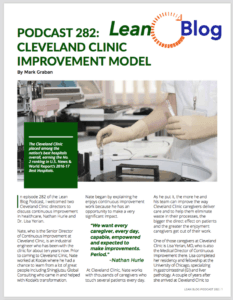
PDF Episode Summary
You can read a PDF summary of this post, below:
- Low-res PDF (for reading on screen)
- High-res PDF (for printing)
Thanks for reading and listening!
Follow the Lean Blog Interviews podcast
Since 2006, I've been talking with leaders, authors, and practitioners about how Lean thinking works in the real world, in healthcare, manufacturing, and beyond. Follow the show so you don't miss new episodes.
Full Episode Summary
This summary was originally published as a PDF in May 2017. The text below is from that PDF.
Jump to a section:
In episode 282 of the Lean Blog Podcast, I welcomed two Cleveland Clinic directors to discuss continuous improvement in healthcare, Nathan Hurle and Dr. Lisa Yerian.
Nate, who is the Senior Director of Continuous Improvement at Cleveland Clinic, is an industrial engineer who has been with the clinic for about ten years now. Prior to coming to Cleveland Clinic, Nate worked at Kodak where he had a chance to learn from a lot of great people including Shingijutsu Global Consulting who came in and helped with Kodak's transformation.
Nate began by explaining he enjoys continuous improvement work because he has an opportunity to make a very significant impact.
At Cleveland Clinic, Nate works with thousands of caregivers who touch several patients every day.
As he put it, the more he and his team can improve the way Cleveland Clinic caregivers deliver care and to help them eliminate waste in their processes, the bigger the direct effect on patients and the greater the enjoyment caregivers get out of their work.
One of those caregivers at Cleveland Clinic is Lisa Yerian, MD, who is also the Medical Director of Continuous Improvement there. Lisa completed her residency and fellowship at the University of Chicago, specializing in gastrointestinal (GI) and liver pathology. A couple of years after she arrived at Cleveland Clinic to establish a career as a GI and liver pathologist, she started being asked to get involved in problem solving within the laboratory, and through that she started to learn about Lean.
“There were multiple elements that really resonated with me; I liked things being very visual. As a pathologist, I look at slides all day, I am a visual person, and so I like the way that a lot of the work was made visual so everybody could see it,” Lisa said. “The concepts, they're not of course easy, but they are conceptually very simple and I found that very pleasing. And then I really loved the philosophical side of respect for the worker and the place where the work is being done.”
Cleveland Clinic has a worldwide reputation for clinical excellence, so I asked Nate and Lisa about the impetus for continuous improvement there.
“I would say that the Cleveland Clinic has long been focused on ‘patients first.' It's our mantra and we very much try to make that real for every patient who comes through our doors. Much of ‘patients first' can be delivered through individual effort, through discretionary effort, though empathy, or through the work we do as individuals, but there is a huge component of ‘patient first' that we can't do as individuals and we can't do just by trying hard,” Lisa said. “In 2006, we started a process improvement team here at the Cleveland Clinic. That team went through a variety of phases, looking at both discrete project efforts and standardized tools, and a variety of methods. Ultimately, in 2013, we really started to realize that if we wanted to fundamentally change health care, change the way we deliver it, we had to engage every single caregiver in improvement work. And that was really they only way that we saw to make it big enough and impactful enough to truly deliver the kind of care we wanted to, and that got us on our Lean cultural transformation journey.”
Improvement Model
Nate explained that, while continuous improvement is a department at Cleveland Clinic, they really try to talk about it more in the context of what they call the improvement model, which is a model that serves all their improvement work and that they want every caregiver to be engaged with.
“I think one of the key points around the way we talk about continuous improvement here is that, although our department is called continuous improvement, we have worked hard to eliminate the perception that our team is the only team engaged in continuous improvement. Continuous improvement is the work of the organization to improve the quality, safety, experience of care, the efficiency of our care, and access to our care, but it's everybody's work,” Lisa said. “We're stewards of the organization, to help all of those 51,000 caregivers do that better, do that as well as they can. Our job is to support the continuous improvement of the rest of the organization.”
If you would like to view the visual of the Cleveland Clinic Improvement Model, you can find a link at leanblog.org/282.
“I think the most important point is that we didn't start with a model, we started with a problem we were trying to solve, or a state we were trying to achieve. So, Nate and I didn't sit in a room and say, OK here's our model, now let's go transform this organization. We flipped that,” Lisa explained. “And so instead of being prescriptive, we engaged one leader and one team in partnership and said help us figure out how to do this.”
Cleveland Clinic caregivers are highly engaged, so when thinking about what could be changed to change the culture of the organization, the team landed on capability, Lisa said. Though the team didn't know exactly all that would be involved under that, they knew problem solving was important and so they began with some A3 problems the team worked on together, providing feedback to the continuous improvement team as they worked through it with them.
“Problem solving remains in the model, but, as we were doing this first cycle of A3 capability building, the leaders that we were working with in this very first model area started to identify the need for the other systems,” Lisa said. “When we worked with team after team after team, all of that input and learning that we were gaining together became the model, that information of what are the systems that are required in our organization in order to do this.”
Nate added that it was a collection of teams and a collection of individuals that created it.
“What we've done since then is we continue to refine that model on an annual basis, so standardization is one of those four systems, we believe in it ourselves, and so we follow the current standard until a new one is discovered,” he explained. “Part of what works really well about that, in calling it the improvement model, is the engagement and partnership we have with other parts of the organization, with our quality and patient safety institute, with our patient experience office, with human resources, they all contribute to defining what they model is so that we can equally support it in practice.”
Nate explained the continuous improvement team also works with the organization to identify specifically where they want to build this culture. Once his team identifies those specific areas with senior leaders, then the team partners very directly with local leaders.
Empowering Leadership
“It's a side-by-side partnership. Our role is to coach the leaders and the frontline, and their role, and they know this walking in, is to really learn and sustain it,” Nate said. “What we've seen over and over again, is because you have the whole community supporting it, you have all the frontline, you have the managers, it's sustaining because they're teaching each other. When a new person comes in, it's not our team that is going back and teaching people how we do this work, it is their own local team.”
Lisa added that people engage and learn in a different way when she creates the expectation upfront that her team is leaving and the department itself is going to be expected to continue to lead improvement and build capability across their team to lead improvement, to solve problems, etc.
“I look at my own experience training residents, fellows, medical students; you can really see a difference between those who don't seem to realize someday they're going to have to do this on their own and those who are very close to needing to be able to do this on their own. Those who have the expectation that they're going to need to turn around and do this themselves and teach it themselves tomorrow engage and learn in a very different way and that's what we were working toward.”
Nate explained that the continuous improvement team gets the most excitement from the stories that happen when their team not there.
“I think I heard this from you before Mark, where someone had asked you, ‘How do you know when improvement is really part of the culture?' And it's really when you can't separate it.” Nate explained, adding that's the direction Cleveland Clinic is headed. “I think part of our role is a little bit of a newspaper reporter. What I mean by that is they're not really our stories, they're our nurse manager's stories, they're our leader in our finance division's stories, it's their stories, and sometimes we get a chance to share those, but more often we like them to share their stories. We have them do the report out, our continuous improvement people are at the back of the room, kind of that proud parent if you will, and that's really where the satisfaction comes in is seeing that transformation occur with those that are really doing the work.”
Looking for Hard Answers
I sometimes get questions from leaders looking for definitive answers on the number of people needed in a dedicated central improvement function and how much time needs to be dedicated to continuous improvement. I respond that don't know because the organization needs as many as are needed, but I asked Lisa and Nate their thoughts on those questions from the perspective of a central improvement department.
“When people ask how big does your central improvement team need to be, I say, well it needs to be at least one. If you have more than one, you have a start, and really the question isn't how big does it need to be, and we've really shifted this question around to a number of our leaders, the question is how fast do you want to go?” Nate said. “Shifting that question has really alleviated this question of, well how big should the team be. We just keep going back to the organization and say well how fast do you want to go? And then, here's our estimate.”
How much time spent improving is hard to answer. Have some regular activities, that are more your typical meetings where they formalize, as part of their standardization system, formalized when we go through and ensure things like Kaizen event ideas are being worked on and making progress. Typical nurse manager three to four hours a week. And then have a lot of work that is built into the daily process for example daily huddles.
“I would also say that if the leader or manager doesn't want to spend time on a consistent basis it's simply not going to work,” Lisa said. “If they're not going to spend time on it, it's clearly not a priority, and not going to work. So, there's got to be something, there's no magic number though, I think as Nate said it's a question of how fast do they want to go.”
“We actually see the amount of time they spend grow,” Nate said. “For example, we were working with our main campus nursing director. She spends a lot of time inside this work now because she uses it as a way to accomplish her objectives and the work that she needs to get done. So, she doesn't view it as ‘oh, I need to spend 10 hours a week on CI,' it's ‘I need to spend 10 hours a week on improving our business and the way we run our business and ensuring that our goals are aligned and ensuring that we're making progress, making sure that people have the right capability to make improvements,' and so on and so forth. And so I'd say it's one that's probably growing over time not shrinking.”
As for how Nate and Lisa's team will be spending their time going forward, they are busy trying to meet the commitment to the organization of engaging every caregiver in a culture of improvement over the next five years.
“There are about 51,000 caregivers, so that's about 10,000 caregivers per year,” Lisa said. “It means us having 10,000 caregivers in front of us who want to build this culture. It means us being as efficient and as effective as we can be to deliver a quality transformation experience for these caregivers. So really a lot of our work is improving the way we do our work to ensure that we are helping the organization in the best possible way to build that culture.”
“The strongest part of our model is our problem solving systems, and as we're working to spread [culture] to these 10,000. We're also really working to improve the organizational alignment and visual management systems. We believe that is really the next piece for us. And so, we're running these experiments side by side, which some days makes it a little confusing, where we're trying to add more to what a model area is by creating clearer organizational alignment while at the same time trying to spread this to 10,000,” Nate said.
Social Media
I wrapped up our interview on the subject of Twitter and getting the most out of it.
“I think it's fun, I think it sets up our team; some of our teams have done really good work and they like to see themselves recognized, even the ones who aren't on Twitter like to know that their work or their pictures have been tweeted, so it's a good way for us to recognize the great work of the caregivers.” Lisa said. “I think when you look at the challenge that's in front of us in healthcare as an industry, it's great if one of us can figure out something that works well, it's even better if we can all share it and see it and give feedback and learn together. And I think Twitter provides that connectedness between lots of people who are interested in building Lean continuous improvement culture across healthcare, to learn and give feedback and share with each other.”
Nate added that Twitter forces their team's message to be very clear and concise, down to 140 characters.
If you would like to know more about the Cleveland Clinic's improvement efforts you can follow Nate and Lisa at @LisaYerianMD and @NateHurle.
You can also learn more at the Cleveland Clinic Patient Experience summit in May, where Lisa will be speaking about how continuous improvement is better not only for patients but also for caregivers. Lisa will also be sharing some examples of how Cleveland Clinic's teams have improved the experience of patients and what that's really meant for them as caregivers and how that's changed how they engage with each other and engage with patients going forward.






Great podcast Mark! So helpful to hear more about the Cleveland Clinic’s improvement model and overall approach to continuous improvement. As a CI Director at a large AMC it’s inspiring to hear about how an AMC of the size and caliber of Cleveland Clinic has developed a true culture of improvement. Also love Lisa and Nate’s style and approach. Much to learn from them for sure.
Also Mark thank your dedication and work on your podcasts! They are a key part of my personal development plan for sure!
Regards,
Keith Murphy
Thanks, Keith. I’m glad you got a lot out of the episode!
Thanks for your comment, Keith! We continue to learn from others (especially Mark!) so we’re happy to share whatever we can! We’re glad you found it helpful.
Lisa