Creating a Continuous Improvement System in Accounting: Nick Katko on PDCA, Culture, and Psychological Safety
Accounting teams see problems every day. As Nick Katko puts it, they fix them, but they don't necessarily solve them. We talk about what a continuous improvement system looks like inside an accounting department, the three parts of that system, and why culture and psychological safety have to come before improvement events. Nick shares an accounts payable team that cut invoice defects from about 43% to 15% by starting with data, and a harder story about what happened after the one person who spoke up about month-end close was fired.
Scroll down for how to subscribe, transcript, and more
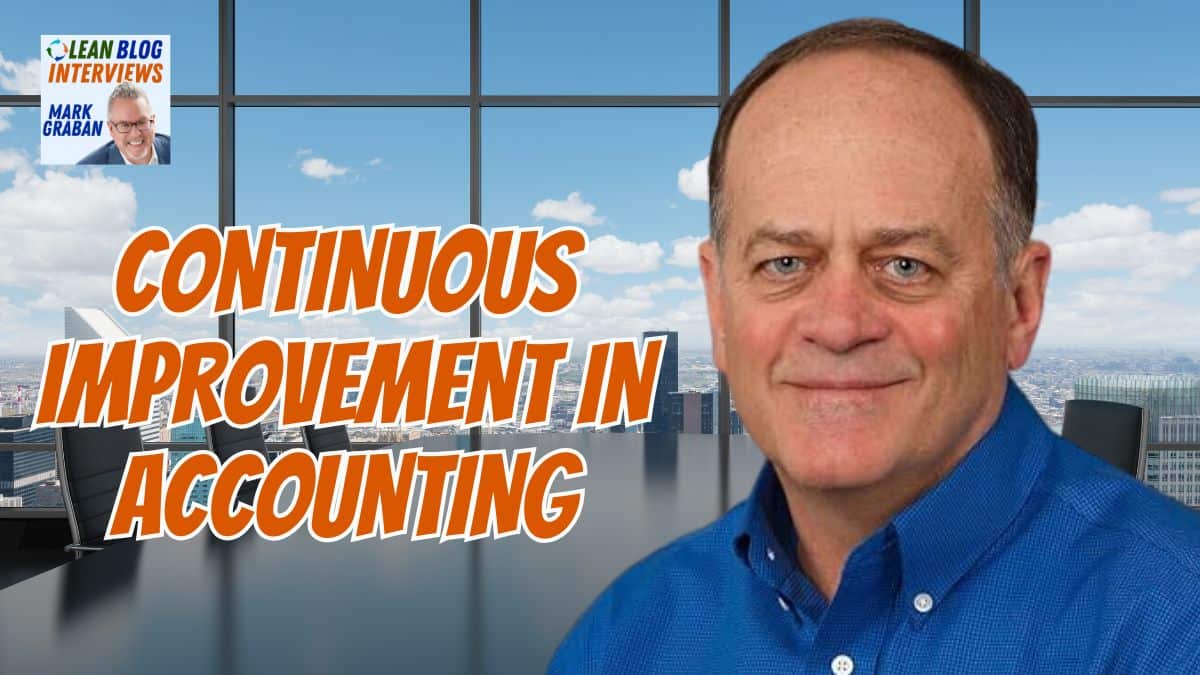
My guest for Episode #549 of the Lean Blog Interviews Podcast is Nick Katko, returning to the show after his previous appearance in Episode 492. Nick is president and owner of BMA, a CPA, and a lean accounting practitioner with more than 30 years of experience. He is the author of The Lean CFO (first published in 2013 and updated in 2023) and co-author of Practicing Lean Accounting and The Lean Business Management System.
His newest book is Creating a Continuous Improvement System in Accounting, which he published independently. It grew out of coaching two accounting teams in Ohio, and it comes with a companion webpage of checklists, assessments, and short training presentations that accounting leaders can use with their own teams.
We talk about why many accounting leaders misunderstand continuous improvement, often because it was done to them by someone else in the company. Nick describes the difference between fixing a problem and solving it, and he shares an accounts payable example where a team cut invoice defects from roughly 43% to 15% after they started by gathering data instead of jumping to solutions.
We also get into the harder territory of culture and psychological safety. Nick tells the story of a month-end close engagement where the one person who clearly explained the systemic problems was fired between visits, and what that did to the rest of the team. He explains why he put the culture chapter near the front of the book, and why he walked away from that engagement rather than run it the top-down way leadership wanted.
What You'll Learn
- Why the book focuses only on accounting instead of being another general Lean book
- The difference between fixing a problem and solving it, and why accounting teams default to fixing
- How an accounts payable team used defect data to cut invoice problems from about 43% to 15%
- The three components of a continuous improvement system in accounting: simple PDCA problem solving, daily lean management, and improvement events
- Why accounting leaders should not leap into improvement events before people understand PDCA
- Why big initiatives like AI (and blockchain before it) distract from the small improvements that add up
- Why time and permission, not ability, are the main reasons problems go unsolved
- How to separate the process from the person when one person is the entire process
- Why psychological safety is situational: what changes when a leader enters or leaves the room
- How a daily problem-solving huddle ended finger-pointing between accounting and purchasing
- How to measure a faster close in person-hours, not just calendar days
- Lessons from independent publishing: layout, editing, and why the grandchildren drew book covers
Questions and Topics
- How did the book come to be, and why not write another general Lean book?
- What makes this more than a book? The companion website with checklists, assessments, and training presentations
- Why do accounting leaders so often misunderstand continuous improvement? “Done to them” by the CI director
- Fixing vs. solving: putting out the fire and putting it out again next month
- The accounts payable story: gather data for a month, find the top two causes (approvals and item not received), run improvement events
- Moving the right numbers in the right direction as a way to explain CI to accountants
- Three parts of the system, building on Art Smalley's four types of problems and Jamie Flinchbaugh's work
- Quick and easy kaizen (Norman Bodek) as the foundation for bigger problem solving
- Breaking an ERP implementation into smaller problems to solve
- AI can help with data, but it can't tell you how to change the process
- Why accounting teams set problems aside: there is always another invoice
- Planning improvement events so people aren't pulled from their work for three full days
- When one person does all of accounts receivable, criticizing the process feels personal
- The story: the woman who explained the month-end close problems and was fired before the second visit
- Amy Edmondson's definition of psychological safety, and forms of punishment short of firing
- The CFO who read the book and left the room, and how the team's tone changed
- How Nick handles a leader who drops in mid-session: asking a team member to repeat what they said earlier
- The culture chapter and the leader self-assessment
- Why leaders can't accurately self-assess psychological safety: you don't know what people aren't saying
- “They can come to me, I have an open door” and why that isn't enough
- Fear and futility as the two reasons people stay quiet (from Mark's upcoming book The Silence Tax)
- Accounting sits at the end of order-to-cash and procure-to-pay, so it sees the problems upstream didn't solve
- Toyota's final inspection and closing the loop back to the source
- Accounting blames purchasing, purchasing blames accounting: the daily problem-solving huddle with sticky notes and who-does-what-by-when
- Mark's healthcare parallel: crooked labels on blood tubes, and what happens when the ED and the lab meet
- Why Nick told the president, CFO, and controller he couldn't help them anymore
- What a faster close is worth: person-hours, time for analysis before an earnings call, bank reporting deadlines
- Independent publishing vs. Taylor & Francis: control over length, figures, title, and cover
- Finding a layout person and why your brain skips over your own typos
- Zeta, Noah, and Asa's hand-drawn book covers inside the book
This podcast is part of the #LeanCommunicators network.


Watch the Episode:
Thanks for listening or watching!
This podcast is part of the Lean Communicators network — check it out!


Follow the Lean Blog Interviews podcast
Since 2006, I've been talking with leaders, authors, and practitioners about how Lean thinking works in the real world, in healthcare, manufacturing, and beyond. Follow the show so you don't miss new episodes.
Introducing Nick Katko and His New Book
Mark Graban: Hi, welcome to Lean Blog Interviews. I'm your host, Mark Graban. Joining us today is returning guest Nick Katko. He is the president and owner of BMA. He's spent more than 30 years working in lean accounting, working with companies ranging from family-owned businesses to multinationals across manufacturing and many other sectors.
He's the author of a book we talked about previously, The Lean CFO. It was first published in 2013 and updated in 2023. It's been translated into Italian, Turkish, and Russian. He's a co-author of Practicing Lean Accounting, from 2021, and co-author of The Lean Business Management System. And we're going to talk today about his newest book. It's titled Creating a Continuous Improvement System in Accounting.
Nick is a CPA. He has a bachelor's in accounting and an MBA in finance, both from UK, which in Kentucky means, of course, University of Kentucky. He's joining us from Lexington. How are you, Nick?
Nick Katko: I'm doing fine, Mark. Thanks for having me on again.
Mark Graban: Happy to have you here. I'll point people back to Episode 492, your most recent appearance. In the past I've asked Nick about his lean origin story. Today we're going to talk about the origin story for the new book, and again, it's Creating a Continuous Improvement System in Accounting. Tell us how the book came to be.
The Origin of the Book
Nick Katko: I've been working with accounting teams for a long time on improving accounting processes, but starting in 2022, 2023, I started working with two companies. They were in Ohio, and I could actually drive there. Neither one started out to be a long-term engagement, but they sort of turned into long-term engagements because I was helping them.
I was less of a consultant and more of a coach, and we were working on all kinds of improvements. And I started thinking, there's something here. But I didn't want to write another lean book.
Mark Graban: Why is that? There are plenty of lean books, and you have a lot to say.
Nick Katko: I know, but there are just so many out there. I'm talking about a general lean book. But then I said, hey, I'm working with accounting teams, and the way I'm talking to them, to help them understand it without getting very technical… I just said, well, just focus on accounting.
So about a year ago, I just sat down and started writing. I helped them build systems and problem-solving systems, and so that was the origin. I worked on it at my leisure and put a big push on it earlier this spring to get it finished. But it's more than a book.
Mark Graban: In what ways?
Nick Katko: I thought about writing a book, and how can you have checklists and assessments and stuff like that? And I thought, you can put them in the book, but that doesn't help anybody. There's a webpage on my website which has all of these supplemental materials. Checklists, assessments. I even created short presentations that people can use if they wanted to train their team. So it's sort of like everything you need, if you're an accounting leader, to help you put your system in place.
Mark Graban: It makes it a more interactive product for people who have bought the book.
Nick Katko: That's it.
Why Accounting Leaders Misunderstand Continuous Improvement
Mark Graban: So why, following up on The Lean CFO, a broader book, why the deep dive into continuous improvement as a part of lean accounting, what a lean CFO should be leading?
Nick Katko: Because over the years, talking with accounting leaders, a lot of them, not all, but many had misunderstandings about what this means. They may have heard it from lean leaders in their company. I remember a few stories where I was talking to CFOs or controllers and they said, “Oh yeah, the director of continuous improvement came by and wanted us to do lean.”
And I said, “What did he do?” “Well, they want to do value stream mapping, they want to do this, they want to do that.” And it was like, “We don't understand this.”
Mark Graban: It sounds like, and this happens a lot, it was being done to them?
Nick Katko: Yes. And the other thing is the acknowledgement of problems. Accounting knows that problems exist in processes, and as part of their work, a lot of their regular work, it's like, “Well, we just have to fix it.”
Mark Graban: And it comes back to, what do they mean by fixing?
Nick Katko: We fix it, but we don't solve it necessarily.
Mark Graban: Does that imply short term, put the fire out?
Nick Katko: There's the element of fire.
Mark Graban: And we fix it again when it happens again.
The Accounts Payable Example: Starting With Data
Nick Katko: Yes. And working with these two teams, it was like, “Hey, you do have a problem in accounting.” One team said, “Hey, we have a problem in accounts payable.” “What's the problem?” “Oh, we have a lot of problems with our invoices. We can't process them.” “Okay, fine.” So I said, “Gather some data.”
Mark Graban: Let's understand the problem better, more specifically.
Nick Katko: I said, “Gather data. I'll be back in a month.” I come back in a month, and they have it. They have their accounts payable invoice defects, meaning they can't process a supplier invoice. Number one reason: approvals. Number two reason: item not received. Everything else was minor. That led to a series of improvement events, and it reduced the defect rate from something like 43% down to 15%. All because they had data.
Mark Graban: Data as the starting point to dig in and ask why and do some more systemic problem solving. Problem prevention for the future.
Nick Katko: Yes. And that's what they really did. They figured it all out. And I always like to tell accounting people, continuous improvement isn't hard. It's about moving numbers in the right direction, but it's the right numbers to move. When they realize that, because we all think numerically, it's like, okay, I can move a number. That helps simplify things. It explains the why. Why do we have to do this?
Three Components of a Continuous Improvement System
Mark Graban: And to me, continuous improvement, or a continuous improvement system, as you call it in the book title, implies something that's ongoing as opposed to a project, an event, rolling up our sleeves to solve something that happened last week. An ongoing system. Tell us more about how you would define it. What are the major components of a system?
Nick Katko: I define it as three, and it's sort of a take on Art Smalley's four types of problems, and even Jamie's People Solve Problems.
Mark Graban: Jamie Flinchbaugh.
Nick Katko: Flinchbaugh, yeah. So you have simple problem solving. This is, Mark, you're my manager. I come to you with a problem, and you guide me through a simple PDCA process to solve it. But I'm doing it. You're doing the coaching. And you learn about it. You learn PDCA. This is the whole point I'm trying to make in the book. Learn what PDCA is and how to use it, it being a thinking process.
Then there's daily lean management. Accounting people have a tendency, they don't have a daily production meeting. They don't have a daily huddle. Everybody comes in and they just do their work. So the idea of doing huddles and measuring and understanding how did we do today, that helps reveal problems. Gap-from-standard problems.
Then the third piece is true continuous improvement events. And one of the points I try to make is don't leap into continuous improvement events when people don't really understand the PDCA process.
Mark Graban: I think of people like Norman Bodek, guest number one on the podcast. I always try to credit the late Norman Bodek. This podcast was really his idea. Having practice with what he called quick and easy kaizen, small improvements, relatively low risk, a relatively simple PDCA cycle or cycles, is to me a good foundation for working on bigger problems and using more rigorous methods, whether that's an A3 methodology or a kaizen event framework, which is often governed by an A3 process, or a longer project. I imagine there are some more transformative improvements. Putting in new accounting software is probably not a kaizen event. That's a big, huge project. But that probably goes better with experience in PDCA.
Nick Katko: Yeah. One of the companies was moving towards a new ERP system, and I made the suggestion, I said, “Let's break this down into smaller pieces and understand what are the problems you want to solve.”
Mark Graban: And they might say, “The problem is we don't have ERP.” Well, let's step back a little.
Big Initiatives Versus Small Improvements
Nick Katko: And the other thing in accounting, in the accounting profession in general, whether it's continuing education classes for CPAs or professional publications, the tendency is to think about big improvements. How can we use AI? And a few years ago, and I haven't heard much about this lately, it was blockchain. Blockchain is going to eliminate having to do any transaction between companies, and you can just exchange the information.
Mark Graban: And if you ask somebody, “How'd that work out?” they'd say, “Well, let me tell you about AI.” The new shiny object.
Nick Katko: So that's another point. It's not the big things, it's the little things. It goes to the fact that, as all real lean practitioners know, the people that are doing the work are the ones who have to solve the problem.
Mark Graban: It's a classic Toyota or lean problem-solving strategy, when you can break the problem down. A big problem or big initiative around AI might really be hundreds of small improvements utilizing AI. KaiNexus, the software company I'm involved in, that's really been a big part of the approach KaiNexus has been using, encouraging people… it's basically AI-enabled kaizen, or the kaizen mindset of, how do we use AI to automate something that used to be really manual? How do we try to do things better? As opposed to saying everybody has to use AI. No, that's just one other thing we would use to try to accomplish things we're already trying to accomplish, toward goals of the company and the customers.
Nick Katko: And AI may be able to help in terms of data, but AI can't tell you how to change the process.
Mark Graban: It might try.
Nick Katko: It might try.
Mark Graban: It always has an answer. It might be an overconfident, non-gemba-based answer.
Why Problems Don't Get Solved: Time, Not Ability
Nick Katko: The problems in accounting that I've encountered over the years, they're not necessarily difficult to solve. It's really giving people the time to solve the problems and an approach to solve the problems, rather than just sitting around in a conference room trying to figure it out.
Mark Graban: That's interesting. If we were to ask why we don't have more continuous improvement, there would be many things on the fishbone diagram, and lack of smarts, lack of caring, lack of ability are probably not really on there. Like you said, it's time and encouragement and other factors.
Nick Katko: Accounting teams always have work to do. Even if I have a problem, like a problem with an invoice in accounts payable, I can set that aside, or I can email it to the purchasing department and say, “I need help,” and then I can just keep working.
Mark Graban: There's another invoice to be done. And that's pressure. I've seen that happen in healthcare settings. Until leaders give active permission to work on continuous improvement, there's this catch-22. Like you said, there's always another patient record to work on. There's another patient to work on.
Nick Katko: I think one of the keys is, even with simple problem solving, to show that in a short period of time you can solve a problem. And then it opens up their mind. The next time I encounter a problem, I'm going to take the time to solve it, because it's pretty simple and the solution is quite apparent. I'm not going to just wait. It develops that mindset. That way, when you're going to go in and do a three-day continuous improvement event on reducing month-end close, you know why you're being pulled out of your job for three days.
Mark Graban: And how often would somebody panic and say, “That's going to put me three days behind in my work”?
Nick Katko: I talk about this in the book in terms of planning improvement events. If you do a good job planning before you even start the event, you can take that into consideration. How long should every day be? It's not going to be 8:00 to 5:00. Maybe we only do four hours for the day. Or maybe we take a break during the day. And the more that you get the data that you need upfront, the easier it is. As opposed to walking into a room and saying, “Okay, let's do the event. Where do we start? Write a problem statement.”
When One Person Is the Process
Mark Graban: One thing I want to touch on, looking to the book, and I think there are parallels for other professional settings if we have people listening who are not accountants. When we try to separate looking at the process, not the people, you might have work that's only done by one person, so they feel like they are the process. And criticizing the process still feels very personal. How do you help people address that?
Nick Katko: That's where learning about psychological safety from you has helped a lot. And that is true. I've worked in small accounting departments where you have one person who does the work in accounts receivable. So you have to create that psychological safety upfront. You've got to make sure that the accounting leaders understand what it means, that you can't point any fingers. You've got to give them freedom to talk. If they're talking about a problem, thank them for talking about the problem, and listen to them. That is of utmost importance. Can I tell you one story about this?
Mark Graban: Please. That's what podcasts are for.
The Person Who Spoke Up and Was Fired
Nick Katko: This was years ago. A company wanted me to help them on month-end. So I went there, we did some training, we laid out the current state, and the next event was scheduled a few weeks later. The idea was we're going to work on a future state, so they had homework to do.
The primary reason that it took a long time to close was getting manufacturing transactions closed. And this one woman in there was very articulate about it. A lot of it was her responsibility, but she understood why it was going on.
All right, great. I come back, and first the controller wanted to have a team meeting. So we have a team meeting, and the controller says, “You've got to get this done fast, team. We need a fast close fast.” Okay, fine. And then he leaves, and I asked the other people, “Where's this woman?” And they said, “Oh, she was fired.”
I mean, she was the one who spoke up, and they let her go. I couldn't believe it, because she knew what she was talking about, and she wasn't blaming anybody. She was just stating facts. And it was really sad, because the event struggled after that.
Mark Graban: Well, sure. Other people witnessed what happened, directly or indirectly, or they heard what happened, or they heard a version of what people think happened. That's not going to help others feel safe enough to speak up.
Nick Katko: And so that's just the thing. You've got to make sure that stuff is in place, that people can talk about it, and nobody's going to point a finger. And I think that's true, like you said, in any administrative process. It's true in all professional services, where I'm doing the work.
Punishment Comes in Many Forms
Mark Graban: Let's talk more about psychological safety, because you shared that sad story of something that crushes it, disincentives to speaking up. I'll come back to Amy Edmondson's definition of psychological safety, which is basically that you feel safe to speak up about basically anything, mistakes, problems, ideas, disagreements, et cetera, without fear of being punished, marginalized, humiliated, what have you.
There are forms of punishment that are less obvious and less severe than being fired. The punishment could be being frozen out, not being involved, feeling less valued, in a way that hurts more inside. You're still getting your paycheck, but if somebody feels disrespected, uninvolved, beyond continuous improvement, that hurts their commitment to the company, to the team, which is understandable.
Nick Katko: I worked with another team where the CFO contacted me. He'd read the book. Okay, great. Went in, met with him and his team, and everybody's on the same page. He had to leave for a meeting, and the tone with the rest of the team changed, because he wasn't there. Even a few of them said, “He won't listen,” or, “He doesn't have time for us,” and stuff like that.
I worked with this team for a while. It ended up there was turnover. There was a promising person who really… you know how people sort of intuitively get problem solving, PDCA, and it's natural for them? This person was like that. You could see the light bulbs going off and the energy, and she couldn't get anything done. She eventually got a different job. And it didn't matter too much to the other people.
Psychological Safety Is Situational
Mark Graban: That scenario illustrates that psychological safety is situational. It's not an inherent trait. You add one person to the room or remove one person from the room, and people may feel more safe or less safe to speak up. Same people, different circumstances.
You might have people within an accounting team that have a high sense of psychological safety within their team. Now you put them in a cross-functional kaizen event with a bunch of lean geeks using jargon, and they might feel less safe. Not afraid of being punished, but maybe afraid of being embarrassed because they used a lean term the wrong way, or somebody might give them a look. They're out of their comfort zone.
I think that's an important role of a kaizen facilitator, to more actively help people feel safe. A lot of kaizen event facilitators try to say, “This is a safe space. Check your title at the door.” Saying that may or may not have a helpful impact. It sounds like you recognize that scenario. What should leaders be doing if we can't just declare, “Hey, you should feel safe”?
Nick Katko: That is true even when you have a team, and this has happened, and it's sort of the opposite of what I just said. You've got a team, you're working with the team, and then the leader comes in because he or she just wants to check in. And there's just this subtle shift.
It's really important to keep the team. The few times that's happened to me, I'll go back and I'll remember something someone said that was really good, and I would say, “Mark, why don't you just say again what you said earlier today about the root causes of the problem?” You allow them to say it in front of the leader, and I guess they feel a little better because the facilitator's also there.
But you've got to be very aware of those situations. I have a whole chapter in the book on culture, creating the culture. And there's even a culture assessment that a leader can take. It's really the leader's assessment of how he or she creates the culture. It's one of the early chapters, and it's there on purpose. You've got to create the culture before you can start doing this stuff. And where are your gaps?
Can Leaders Accurately Assess Their Own Culture?
Mark Graban: One of the interesting things to see is how accurately leaders can self-assess. Sometimes leaders have an overly rosy view of, “Yeah, people are safe to speak up around here,” but the leader doesn't know what people are holding back. By definition, you don't know the things people aren't saying.
Unless somebody at some point has clued you in and pulled you aside and said, “I don't think the real issues are coming out here in the discussion.” You may get some hints that people aren't being fully candid, but sometimes leaders will turn that back as a criticism of the people. “Well, it's their job to be candid.” I'm sure they want to be candid if they felt like that candor was well received.
Nick Katko: When you started talking about that, it reminded me of a few instances where I'm going to the owner. This may have been more of a lean management accounting engagement. The owner said, “How are things going?” And I talk about some of the problems or issues that were raised. And they get this look, and it's like, “Why haven't they talked to me about this?”
It's just what you said. I said, “I think they're a little hesitant for some reason.” And the same line comes out: “They can come to me. Why don't they come to me?” I'm like, “I can't answer that question, because I don't work here.”
Mark Graban: “I have an open door.” In fact, it's a policy. It's an open door policy.
Nick Katko: The more I've done this work, the more it's just about the people and the relationships. With the right relationships in place, and respect for people, you can get anything done. You can tackle any problem.
Fear and Futility
Mark Graban: Back to the question about the leader not knowing why people hold back, why they keep quiet, why they don't speak up, however you want to frame it. Let me get your reaction to this. I'm going to be a little self-promotional about my upcoming book, The Silence Tax: How Lean Leaders Drive Out Fear and Futility. Those are the two core reasons. If you answer that question, why people don't speak up, I think everything would fit into a fishbone diagram with two huge bones. It's either some element of fear or some element of futility.
I'm curious if you think of situations where people would say, “I won't get in trouble for speaking up. It's just nothing happens.” That's futility. Have you run across that?
Nick Katko: Yeah, I have. I've also run into where people forget to follow up on something. They know something's wrong, and this has happened in some accounting teams. Someone knows something's wrong. They put it aside, they forget about it, and then somebody else finds out about it. Or the controller finds out about it through someone else, not pointing the finger at the person in accounting, but just saying, “This hasn't been resolved.” Why hasn't it been resolved?
I think that gets into, why am I putting it aside? It could be I'm busy. It could be I'm not sure how to talk about this. Then there's the subtle blame. Accounting is at the end of the process, like order to cash, procure to pay. When I was CFO, I used to tell this to my accounting team: “You're going to see the problems that don't get solved upstream. You have to do this the right way. You can't point fingers. We're just in this unique position, and let's work with them to solve their problems. Doesn't matter what the problem is.”
Closing the Loop Back to the Source
Mark Graban: That makes me think of a loop that would happen at the very end of an assembly line. Toyota, as much as they emphasize building in quality and mistake-proofing, their plants still have final inspection. That surprises people sometimes. “What do you mean Toyota still has final inspection? You can't inspect in quality.” They don't have perfect built-in quality yet, so they've decided final inspection is less wasteful than letting defects go uncaught.
But part of that process at the end of the assembly line is absolutely to close the loop back to the source of the defect. Not just, to use an example, touching up the paint ten times a day, but trying to trace back, where's the car getting scratched? Is there a similar thing that happens with accounting? It seems like accounting is maybe more physically disconnected than inspection is from the assembly line they can walk to. That might be a challenge.
Nick Katko: It depends on the size of the company. One company I worked with a few years ago, I was assessing things, and I talked to accounting, and accounting complained about purchasing. Purchasing can't do anything. Talked to purchasing, and you know what they did? They complained about accounting. And they were saying the same thing. They were just pointing the fingers.
I said, “Okay, let's create a huddle. Not a daily lean management huddle, but a daily problem-solving huddle.” As opposed to sending the emails, because if I send the email to you, Mark, you might read it, but it becomes low priority because you've got other things to do. I said, “You do a huddle. Put the problems on sticky notes and put them on a board. Spend 15 minutes and say who's going to handle what problem, and get it done by the next day.” And all of a sudden, it works. They like it.
Mark Graban: That's part of a system. A system helps you not lose track of ideas to work on. That system could be a bulletin board, it might be a spreadsheet, it might be software. But there's a system.
Nick Katko: It's who's going to do what by when. And they made their commitment, their time commitment. “Okay, I'll have that done tomorrow,” which means now they have to figure out how to get it done, and they build it into their schedule. It's very informal, but you're teaching people how to deal with problems and not just get the work done.
I even did that with another company. Actually, they figured it out themselves. They would have a huddle every two or three days. Accounts payable and supply chain would get together and talk.
A Healthcare Parallel: The ED, the Lab, and Crooked Labels
Mark Graban: Breaking down those silos, I've seen this happen in healthcare. The finger-pointing stops. It's easier to blame what I loosely call the anonymous jerks in that other department. You don't even know their names.
One story that comes to mind, the equivalent in healthcare would be nurses in the emergency department. They're probably told, and there could be training and communication gaps, that they need to put the label on the tube of blood so it's aligned neatly before they send it to the lab. And the lab, many times a day, these are sent often by a pneumatic tube system, so people never see each other. Tubes just show up. People in the lab are like, “Ugh, there's another crooked label. It's not going to scan properly in the automation.” And what do they do? They print another label and they put it on straight. They touch up the paint, if you will.
There have been times where you actually bring people together. Bring the lab people to the ED, bring the ED people to the lab. More importantly, they see firsthand that if that label isn't pretty perfectly aligned, the lab automation won't scan the barcode properly and the system stops.
The ER people, their mental model might be, “We know those lab people are really fussy and uptight and detail-oriented. I don't have time to put the label on straight. They should feel lucky there's a label on there and it's labeled properly. That's all that matters.” And then they realize, okay, it does matter. Now when people can put names and faces to roles and departments, it's not perfect mistake-proofing to make sure that label is on perfectly straight, but nurses better understood there's a real reason for this. They're not trying to make work more difficult for the lab.
So being able to close the loop, and to set up communication channels to send feedback, not to scold them, but just, “Hey, so you know, there were five tubes yesterday we had to relabel.” That turns into data and hopefully then improvement.
Nick Katko: And that's what happened with the accounts payable team example I gave. Both of the major root causes were related to purchasing and receiving. And through the improvement events that were conducted, the two teams developed a very close relationship. They just started collaborating naturally. Even the two managers would talk a lot more. These were newer managers compared to when I started, but they had a whole different attitude about things.
At one level, it's comforting and it reduces stress, because if I'm in accounting and I run into something, I know I can go see this person and talk about it. I don't have to figure out how to talk about it. I can just go talk, and it can be a casual conversation, like this. I don't have to prepare a three-page email explaining the situation.
Mark Graban: Nobody's got time for that either. There's always other email to work on.
Walking Away From a Top-Down Engagement
Mark Graban: I want to come back a little bit to the story of the woman who got fired. This might be an unfair question, but I'm going to ask you anyway. As a consultant, you were put in a tough situation there. Was there an opportunity to try to bring that up with leaders? Did you feel safe trying to say, “Here's what happened. Let's talk through it. What could be done differently?”
Nick Katko: What really happened is I finished that second visit, and during the wrap-up, which was with the president and the CFO and the controller, the way that they were talking, I basically said, “I probably can't help you anymore.”
Mark Graban: Meaning you were walking away?
Nick Katko: I said, “Here's the way I would approach it. Now, if you want to approach it differently, that's fine. But I can't do it your way.” Because it was really top-down, heavy-handed. Just force it. And I just said, “Thanks.”
It was very apparent that there wasn't any opportunity to try to do it differently, to really try to understand the problems. Because there was an element of denial about what the true problems were, even though that woman articulated it. They had some very systemic problems with manufacturing transactions that had to be fixed.
What Is a Faster Close Actually Worth?
Mark Graban: Back to the more positive side of improvements and changes. You've talked about a faster close. Something Paul O'Neill talked about a lot when he was at Alcoa was that excellence meant every department, every function. He challenged them, and I think they had the fastest close among big public companies.
It's one thing to say, “We map the process, and we take out delays, and we resequence the work, and it could be faster.” But the question I have is, what's the value of the faster close?
Nick Katko: First, it depends on how you measure it. If you just measure it in days, you could close faster and people are working longer hours.
Mark Graban: Just brute force it.
Nick Katko: So what I try to get teams to say is, “How many person-hours does it take to close?”
Mark Graban: So there's a measure of activity and effort.
Nick Katko: Yes. Because if it takes 250 person-hours to close, and you can knock that down to 150, that gives you more time to get back to your regular work. That's the benefit.
Mark Graban: So that's a general effectiveness and efficiency argument. Can leaders make faster, better decisions by having the close finished sooner?
Nick Katko: I think the faster you get the numbers, yes. Now, in public companies, it's really important, because you have the closing of the numbers, then you have the analysis piece, and then you have the earnings call. If it takes long to close, then the analytical piece gets close to when the leaders need information for the earnings call, and they need time to prep. As opposed to, “Here are your bullet points to read.” They may have questions, because they can't anticipate the questions they're going to get in the earnings call. There are iterative loops there. If you're always busy trying to just close, you don't have that time. That's the other advantage.
And sometimes it might not be earnings calls, but you have to send statements to banks and stuff like that. They have deadlines too.
Publishing Independently
Mark Graban: Again, our guest today is Nick Katko. His latest book is Creating a Continuous Improvement System in Accounting. Can we talk a little bit about the process of bringing the book to be? You and I were talking before we recorded. I had published something, a collection of tips and thoughts about ways I go about publishing. Was this your first time? I see here on the copyright page, independently published. I like the phrase independent publishing over self-publishing. Was that your first time doing that?
Nick Katko: No, it was the second time. The 2022 book, Practicing Lean Accounting, was independently published, and I learned the process there. The Lean CFO was through Taylor and Francis, both versions. This one, I said I'm just going to do it myself, because I don't know how long it's going to be, I don't know how many figures are going to be in it. I didn't want to be bound by, “You need 150 pages.”
Mark Graban: And this is cute. I hadn't noticed this yet. Your grandchildren drew their versions of book covers that are inside the book.
Nick Katko: Yes. They get a kick out of it, that their grandfather writes books. Our granddaughter, the oldest one, Zeta, was actually in Practicing Lean Accounting. She's 11 now, and she said, “Am I going to be in this book?” I said, “Okay, well, there are three of you now, not just one.”
It was Father's Day and we were with them, and I said, “Here's what I want you to do for me. Here's the regular book cover. Draw your own, and I'll put them in there.” Zeta's 11, Noah's going to be eight, and Asa is four. That was the fun part about it. And they got their copies too.
Mark Graban: One of the advantages of publishing independently, of being the publisher, is you get to make all of those decisions. Some people would say, “Okay, well, I have to make a lot of decisions.” But I think getting to make those decisions, maintaining control of the project, answering to yourself, being able to bring your vision forward without disagreement over things like the title and the cover and different things.
Nick Katko: For anyone listening who's thinking about maybe a book, the challenge for me this time was finding someone to do the layout, because the person who did the other book retired. I was wrestling with this, and I finally wrote her, and she found another person that was able to do it. There's that piece, the layout, and then there's the proofreading and the editing. What I found is if I keep reading the stuff I'm writing, I know what's there and what's coming, and then you skip over stuff.
Mark Graban: Your brain plays tricks on you. I think even for professional editors sometimes, the connection from your eyes to your brain gets corrupted, and there's what you thought you saw.
Nick Katko: Those were the two big challenges. But we got them done.
Mark Graban: I think it goes to show why self-publishing is usually a misnomer. There might be times somebody does it purely self, but the idea that all the skill sets required would exist in one person might not normally be true. So it's good to get help and input from people, and then you get to publish it independently.
The book again is Creating a Continuous Improvement System in Accounting. As Nick mentioned, there's a website for the book. I'll link to that in the show notes, because of all those extras you mentioned. If you'd gone through a traditional publisher, you'd still set up your own website. You could still do those things. But sometimes publishers want to fit you into a template and their format and their approach. One advantage of doing it independently, for better or for worse, is you can do it your way.
There are some innovative things there. It's great that you're offering some of the interactive material for people as well.
Nick Katko: I tried to write it simple and easy, to the point. It's the way I talk when I'm coaching a team. I don't like to get into complex stuff, so that's why it's a nice thin book that you can read fast and figure out how to make things happen.
Mark Graban: That makes the book useful and action-oriented. Nick, congratulations on getting another book over the finish line and out to market. Continuous improvement, psychological safety, culture, those are all important issues to me, even though I am not an accountant. It resonates with me, and I'm sure it resonated with the listener. Thank you for being back on the podcast again.
Nick Katko: Thanks a lot, Mark. I appreciate it.
Mark Graban: Sure thing.